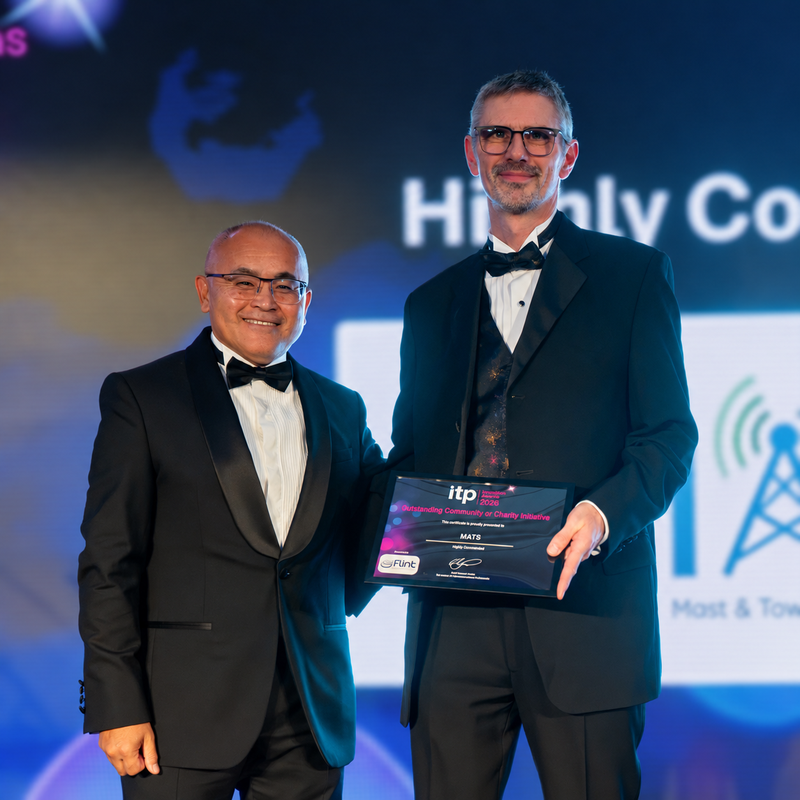
Meet the ITP’s 2026 Highly Commended Recipients – Mast and Tower Safety (MATS) Group
1. Congratulations on being Highly Commended! For readers unfamiliar with MATS, what does the organisation do, and who benefits from its work?
Thank you. It is a real boost for a small, volunteer-led organisation to be recognised alongside such strong initiatives.
Mast and Tower Safety, or MATS, is a not-for-profit industry body for the UK mast and tower sector. It brings together infrastructure owners, network operators, contractors and others in the industry to improve the safety of people working on telecoms structures. We develop and publish practical safety guidance, create and back industry training schemes for tower climbing and rescue and rooftop safety, run consultations on industry issues, and hold a conference every 18 months that brings the sector together.
The people who benefit most are those doing the high-risk work: climbers, riggers and engineers working at height on masts, towers and rooftops. The benefit also extends to their employers, to the wider supply chain and, increasingly, to non-telecoms workers such as roofers and maintenance teams who work near telecoms equipment.
2. Safety guidance and training can seem quite technical from the outside. Can you share an example that brings to life why this work matters to someone working on a mast, tower or rooftop?
Take a roofer, a window cleaner or a building maintenance engineer working on a rooftop that also hosts mobile antennas. They are not telecoms workers, and they may have no idea that standing in front of an active antenna can expose them to radio frequency energy above safe levels. Nothing about it is visible. They just see a box on a pole.
Our RF awareness work for non-telecoms workers is aimed squarely at that person. It explains in plain language what the signs mean, where the exclusion zones are, and who to contact before starting work.
The same applies on towers. A climber who has been through properly assessed climbing and rescue training is not just more confident going up; they and their colleagues know what to do if something goes wrong at height, when every minute counts. Behind every piece of technical guidance is someone who should be going home safely at the end of the shift.
3. MATS’s volunteer directors contribute alongside their full-time jobs. What motivates them to keep giving their time, and what might surprise people about the work happening behind the scenes?
Most of us have spent our careers in this industry and have seen what happens when things go wrong. That stays with you. MATS gives us a way to improve things for the whole sector, not just within our own organisations, and that is a strong motivator.
There is also real satisfaction in working with people who are normally competitors and finding that, on safety, everyone wants the same outcome.
What might surprise people is how much of the work happens in evenings and at weekends, and how much detail goes into it. A single guidance note can involve months of drafting, technical review, legal checks and consultation with outside experts. Running a conference for around 400 delegates without a large paid team is another hidden effort: speakers, sponsors, exhibitors, registration and badges are all organised largely by volunteers, with valued support from our operational admin.
4. Your guidance is freely available across the industry, including to organisations that aren’t members. Why is that wider reach so important to MATS?
Because safety should not be a competitive advantage or a membership perk. The hazards on a mast are the same whether you work for a large operator or a two-person subcontractor, and the smaller organisations are often the ones with the least access to specialist safety advice.
The industry also relies on a long supply chain. Work is often subcontracted several times, and the person actually on the structure may work for a company that has never heard of MATS. If our guidance only reached members, we would be missing many of the people who need it most.
Free access also builds trust and consistency. When everyone is working from the same guidance, it becomes easier to set clear expectations across contracts and sites. We would much rather see our guidance widely used than tightly held. Membership is how organisations support and shape that work; it is not a condition of benefiting from it.
5. How do the people carrying out high-risk work help shape your priorities? Can you tell us about a concern raised by the industry that led to action?
Increasingly directly. Our associate membership brings contractors and training providers into the organisation, our subgroups give them a hand in developing guidance, and our consultations and conference give the wider workforce a chance to tell us what matters to them.
Nesting birds is a good example. One of our members raised a problem they kept running into: during the nesting season, structures were effectively becoming out of bounds, which made it hard to carry out the maintenance needed to keep networks running. Teams were caught between work that had to be done, a legal duty not to disturb protected species, and the risk of rushing or improvising at height to get round the problem.
There was no clear, practical industry guidance, so we produced it. GN021, published in April 2026, gives climbers and planners a straightforward way to identify, plan around and manage nesting birds safely and lawfully, so that essential maintenance can still go ahead.
6. Your recent nesting birds guidance was developed in partnership with the RSPB. What prompted that collaboration, and what did you learn from bringing together different areas of expertise?
It started with one of our members. They kept finding structures becoming out of bounds during the nesting season, which made it difficult to maintain the network, and they made the initial contact with the RSPB. From there it made sense for MATS to take it forward for the whole industry. We knew early on that we could write the working-at-height side of the guidance ourselves, but we could not credibly write about bird behaviour, breeding seasons or wildlife law. The RSPB brought exactly that expertise.
The biggest lesson was how much each side assumed about the other’s world. Our members understood access, rescue plans and outage windows, but not always why a particular species or time of year mattered. The RSPB understood conservation, but not the practical realities of planning a climb on a live network site. Putting those perspectives together produced guidance that is both legally sound and usable on the ground.
It also showed us that some of the best safety outcomes come from looking outside our own industry. We would welcome more partnerships like this.
7. Thousands of people have taken part in MATS-backed training. Beyond the figures, what feedback or experiences have shown you the difference it makes to confidence and safe working practices?
The figures are significant. The Basic Tower Climbing and Rescue programme has delivered more than 9,000 completions, including renewals, since 2020, and the Rooftop Worker Safety and Access programme has more than 12,000 completions since 2022. That is well over 15,000 people trained in the sector’s two highest-risk activities.
But the feedback that matters most comes from the people delivering it. Will Stevens, Training Centre Manager at Circet Academy and one of our associate members, has trained many people on both schemes over more than ten years in the industry. In his words: “These courses go far beyond simply meeting compliance requirements – they genuinely influence how people approach high-risk work. From planning and assessing sites before climbing to responding effectively in emergency situations, delegates leave with practical and safety critical knowledge they can actively apply on the job.”
He also makes a point I think matters a lot: “People don’t just attend once, they return for renewals year after year, reinforcing their skills and keeping up to date with evolving risks.” A common, recognised standard means workers moving between employers do not have to start again, and employers can be confident that someone arriving on site has been trained to the same baseline. That is what turns training from a box-ticking exercise into safer working practice.
8. Your climbing industry consultation explored how training and competence are recorded. What did you learn, and how could the next steps help people working in the sector?
We ran the consultation in partnership with Energy & Utility Skills (EUSR), surveying MATS members and EUSR Approved Providers and promoting it more widely across the industry. Responses came from eight organisations, so we treat the findings as indicative rather than definitive, but the respondents were active, experienced stakeholders and the themes were clear.
The main one was that competence tracking is fragmented. Larger organisations tend to use HR systems and specialist platforms with automated expiry alerts. Smaller firms often rely on spreadsheets, shared folders or paper records, and responsibility for keeping them up to date often falls on the individual climber. That makes it hard for workers to carry a clear record from job to job, and hard for employers to check it.
We also asked about a centralised system linked to EUSR. Views were mixed, and concerns outweighed support: people worried about extra administration, duplicating systems they already have, cost and data protection. They also saw real benefits, though, particularly easier movement between employers, better visibility and more consistent standards.
So the recommendation is not to rush into building anything. The next step is to test the concept with a much wider audience. If it goes ahead, it must work with existing systems, keep the burden on SMEs light and earn people’s trust on data, and it should be piloted first.
9. With limited resources and so many safety priorities, how do you decide where to focus your efforts? What has been the hardest part of sustaining this work?
We approach it in a risk-based way. The questions are: how serious could the harm be, how many people are exposed, and is this something MATS is uniquely placed to tackle? If another body is already doing it well, we would rather support them than duplicate the effort. Where there is a gap that affects the whole sector and no one else is filling it, that is where we focus.
We also listen closely to what the people doing the work tell us, because the issues that matter most on site are not always the ones that look most pressing from an office.
The hardest part has been capacity. For a long time, progress depended on a handful of volunteers, and when their day jobs got busy, MATS work slowed down. That is why we introduced associate membership and subgroups. Sharing the load across more people has made the work far more sustainable, but maintaining momentum with a volunteer workforce is something we will always need to work at.
10. For someone who wants to support MATS, whether an individual or an organisation, what would be the most useful way to get involved?
For organisations, the most useful step is to become a member or associate. That gives you a real say in our priorities and a place in the subgroups developing guidance. It also helps sustain the work for the whole industry.
For individuals, we would love to hear from people with practical experience who are willing to contribute to a subgroup, review draft guidance or share their views when we consult. You do not have to be a safety specialist. Some of the most valuable input comes from people who climb, plan or supervise the work every day.
Everyone can help simply by using our guidance and sharing it, especially with subcontractors and non-telecoms workers who might not otherwise see it. And of course, come to our conference on 25 November at Cranmore Park in Solihull. Sponsorship and exhibitor opportunities are another valuable way to support us. Get in touch at enquiries@matsgroup.info, or follow MATS on LinkedIn.
11. What does this recognition mean to the people who make MATS’s work possible, and what would you most like to achieve next?
It means a great deal. Most of the work behind MATS happens out of sight, in evenings and spare moments, by people who are not paid for it. Recognition from across the industry tells them that their effort is seen and that it matters. That is a big part of what keeps volunteers going.
It is also a recognition of the collaboration MATS represents: operators, owners, contractors, training providers and partners such as EUSR and the RSPB working together on something bigger than any one organisation.
Next, we want to keep expanding our free guidance library, take forward the findings from the climbing industry consultation on competence records, and give an even stronger voice to the people who do the work. Longer term, we want MATS to be recognised as the industry body for mast and tower safety in UK Telecoms, setting the standards, shaping the training and representing the people who do the work. Our conference this November, Weathering Change: People and Infrastructure Under Pressure, will be our biggest yet, and we see it as the start of that next chapter.